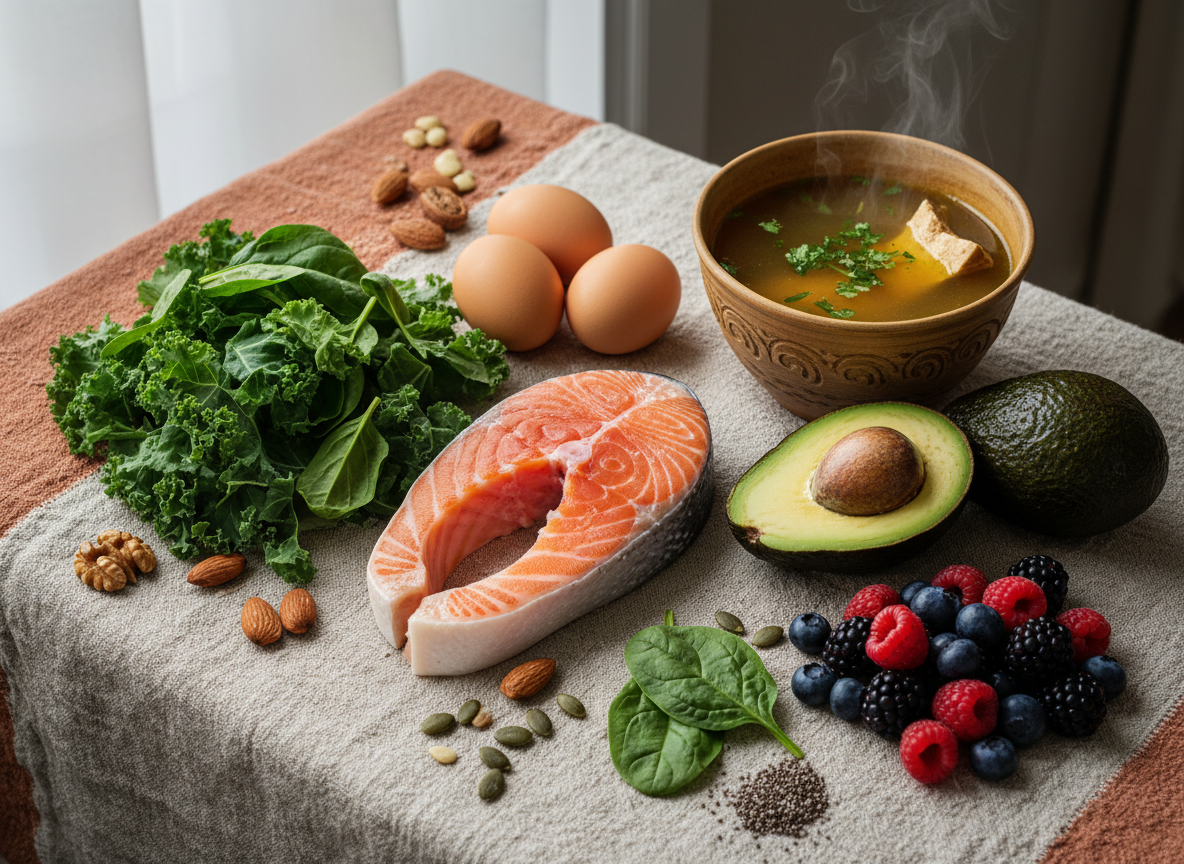
Eat to ActivateYour Body's Peptides
Every bite is either feeding your body's peptide machinery or starving it. Learn which foods deliver the exact amino acids you need.
Why Our Food Isn't Enough
It's not that you're eating wrong — it's that the food itself has changed.
Depleted Soil
Industrial farming has stripped minerals from the soil. Today's crops have significantly less magnesium, zinc, and selenium than 50 years ago.
Antibiotics in Food
Factory-farmed animals are loaded with antibiotics that destroy gut bacteria — and those bacteria are essential for amino acid synthesis.
Processing & Refinement
Processing removes the very nutrients and amino acids that make food valuable. White flour has 80% less zinc and magnesium than whole grain.
Pesticides & Herbicides
Glyphosate and other chemicals disrupt the shikimate pathway in gut bacteria — the same pathway that produces aromatic amino acids.
Foods That Feed Your Peptides
These nutrient-dense whole foods provide the amino acids and cofactors your body needs to produce its own healing peptides.
Grass-Fed & Pastured Meats
Complete amino acid profiles, rich in creatine, carnosine, and collagen precursors that factory-farmed meat lacks.
- Grass-fed beef — leucine, carnosine, CLA
- Organ meats — all essential amino acids + B12
- Bone broth — glycine, proline, glutamine
Wild-Caught Seafood
Rich in omega-3 fatty acids and complete proteins with highly bioavailable amino acids for peptide synthesis.
- Wild salmon — all 9 essential aminos + omega-3
- Sardines — taurine, selenium, complete protein
- Oysters — zinc for immune peptide activation
Pasture-Raised Eggs
Nature's most bioavailable protein source. Contains every amino acid your body needs in perfect ratios.
- Complete protein — all 20 amino acids
- Choline — brain peptide support
- Biotin & selenium — enzymatic cofactors
Dark Leafy Greens
Chlorophyll-rich foods that support detoxification, provide magnesium for enzymatic peptide production.
- Kale — vitamin K, folate, plant aminos
- Spinach — iron, magnesium, glutathione support
- Watercress — most nutrient-dense vegetable
Antioxidant-Rich Fruits
Polyphenols and antioxidants that protect peptide structures from oxidative damage and inflammation.
- Blueberries — anthocyanins, neuroprotection
- Pomegranate — urolithin A, cellular renewal
- Tart cherries — melatonin, anti-inflammatory
Legumes & Seeds
Plant-based amino acid powerhouses that complement animal proteins and support gut bacteria diversity.
- Pumpkin seeds — arginine, zinc, magnesium
- Hemp seeds — complete plant protein
- Lentils — lysine, folate, prebiotic fiber
Daily Peptide-Activating Plate
A simple framework for every meal.
Quality Protein
Grass-fed meat, wild fish, or pastured eggs
Dark Greens
Kale, spinach, arugula, watercress
Complex Carbs
Sweet potato, quinoa, or legumes
Healthy Fats
Avocado, olive oil, nuts & seeds
Why Fasting Is the Most PowerfulPeptide Activator of All
When you stop eating, your body doesn't shut down — it switches into its most powerful repair mode. Fasting activates the same peptide and longevity pathways that pharmaceutical researchers spend billions trying to replicate. And it costs nothing.
Growth Hormone Surges
Fasting for 24 hours increases growth hormone secretion by up to 300% — triggering the same pathways targeted by CJC-1295 and Ipamorelin. This drives fat breakdown, muscle preservation, and cellular repair.
📚 Journal of Clinical Investigation, 1988
Autophagy — Your Body's Clean-Up Crew
After 16–18 hours without food, your cells activate autophagy: a self-cleaning process that breaks down damaged proteins, clears cellular waste, and recycles old organelles. This is one of the most powerful anti-aging mechanisms known.
📚 Nobel Prize in Physiology (Yoshinori Ohsumi), 2016
BDNF & Brain Rewiring
Fasting boosts Brain-Derived Neurotrophic Factor (BDNF) — the same protein Lion's Mane mushroom targets. BDNF stimulates the growth of new neurons, sharpens focus, and protects against neurodegeneration.
📚 Annals of the New York Academy of Sciences, 2012
Insulin Reset & Metabolic Repair
Fasting lowers fasting insulin dramatically and increases insulin sensitivity — the same metabolic target as GLP-1 agonists like semaglutide. Your body switches from glucose-burning to fat-burning (ketosis), lowering inflammation throughout.
📚 New England Journal of Medicine, 2019
Cardiovascular Protection
Intermittent fasting reduces LDL cholesterol, triglycerides, and blood pressure. It also reduces inflammatory markers like CRP and IL-6 — key drivers of heart disease and metabolic syndrome.
📚 Circulation, 2019
Telomere & Longevity Signalling
Fasting activates AMPK and inhibits mTOR — the two master switches of longevity. This mimics the effects of caloric restriction studied in every major lifespan extension experiment, and supports the Epithalon and AICAR peptide pathways.
📚 Cell Metabolism, 2017
What Happens When You Fast
Digestion & absorption. Insulin rises, energy from food.
Blood sugar normalises. Insulin falls. Fat burning begins.
Liver glycogen depleting. Ketone production starts. Body shifts fuel source.
Autophagy initiates. Growth hormone begins to rise. Cellular clean-up begins.
Deep ketosis. BDNF elevated. Significant fat oxidation. Mental clarity peaks for many.
Peak GH pulse (+300%). Maximal autophagy. Full gut rest. AMPK fully activated.
Fasting Protocols — Which One Is Right for You?
16:8
Eat within 8 hours
BeginnerConsistent autophagy, GH increase, insulin reset. Most sustainable long-term.
18:6
Eat within 6 hours
IntermediateDeeper ketosis, stronger AMPK activation, enhanced fat oxidation.
24h Fast
One meal per day
AdvancedPeak GH pulse (300%), maximal autophagy, full gut rest and microbiome reset.
5:2
2 very low-cal days/week
FlexibleCardiovascular benefits, insulin sensitivity, weight management without daily restriction.
Note: Fasting is not appropriate for everyone. Those who are pregnant, have a history of eating disorders, diabetes, or other metabolic conditions should consult a healthcare professional before fasting.
How Food Becomes Biology
Every food below has been scientifically shown to activate specific peptide pathways — the same ones your body uses for healing, energy, and longevity.
Bone Broth
Activates 3 peptide pathways
Glycine, proline, and hydroxyproline directly feed the synthesis pathways for gut repair and tissue-building peptides.
Glycine shown to independently stimulate growth hormone secretion and gut repair (J. Clin. Biochem. Nutr., 2012)
Fermented Foods
Activates 4 peptide pathways
Short-chain fatty acids (butyrate, propionate) produced during fermentation are among the most potent natural GLP-1 and serotonin secretagogues known.
Butyrate increases GLP-1 secretion by 3–5x in gut L-cells (Cell, 2015)
Beef Liver
Activates 4 peptide pathways
The densest source of bioavailable copper, B12, and folate — cofactors for copper peptide regeneration and NAD+ biosynthesis.
Liver is the only food that simultaneously provides all copper peptide cofactors in therapeutic concentrations.
Wild Salmon
Activates 4 peptide pathways
DHA omega-3 is the primary structural fat in neuronal membranes and cardiolipin — the exact targets of SS-31 and brain-derived neurotrophic factors.
DHA supplementation increases BDNF expression by 40% in rodent hippocampus (FASEB J., 2011)
Edamame & Broccoli
Activates 2 peptide pathways
Among the highest known food sources of NMN (nicotinamide mononucleotide) — the direct NAD+ precursor that fuels sirtuins and DNA repair.
Edamame contains ~1.88 mg NMN per 100g — highest plant-based NAD+ precursor found (Nature, 2019)
Tart Cherries
Activates 3 peptide pathways
The highest natural source of dietary melatonin, feeding the pineal gland's production cycle for Epithalon and sleep-repair peptides.
Tart cherry juice increased sleep time by 84 minutes and melatonin levels significantly (European J. Nutrition, 2012)
Lion's Mane Mushroom
Activates 4 peptide pathways
Hericenones and erinacines are the only known dietary compounds that stimulate NGF (nerve growth factor) synthesis in the brain.
Lion's Mane improved mild cognitive impairment scores significantly in 3-month human RCT (Phytotherapy Research, 2009)
Fasting (16:8)
Activates 5 peptide pathways
24-hour fasting can triple growth hormone pulse amplitude, activate telomere repair, and amplify AMPK — the same targets as GH peptides, Epithalon, and AICAR.
Fasting for 24h increases GH secretion by 300% (Journal of Clinical Investigation, 1988)
Pomegranate
Activates 3 peptide pathways
Ellagitannins in pomegranate are metabolized by gut bacteria (Gordonibacter) into urolithin A — the only known dietary compound proven to induce mitophagy in humans, the same pathway SS-31 targets.
Urolithin A improved mitochondrial gene expression in elderly human muscle (Nature Metabolism, 2022)
Walnuts & Almonds
Activates 3 peptide pathways
Rich in ellagic acid and omega-3 ALA — the substrates gut bacteria convert to urolithin A. Walnut consumers show significantly higher gut diversity and Akkermansia abundance.
Walnut consumption enriched Akkermansia and Roseburia in human trials (Nutrients, 2022)
Broccoli Sprouts
Activates 3 peptide pathways
Contain 100x more sulforaphane than mature broccoli — activates Nrf2 and AMPK pathways that mirror MOTS-c and SS-31 mitochondrial signaling.
Sulforaphane activates AMPK and mitochondrial biogenesis in human cells (Science, 2017)
Cranberries & Green Tea
Activates 3 peptide pathways
Polyphenols in cranberries and green tea selectively feed Akkermansia muciniphila — the keystone gut strain that strengthens the gut barrier and triggers GLP-1 release.
Cranberry extract increased Akkermansia abundance by 30% in 4-week human trial (Gut, 2018)