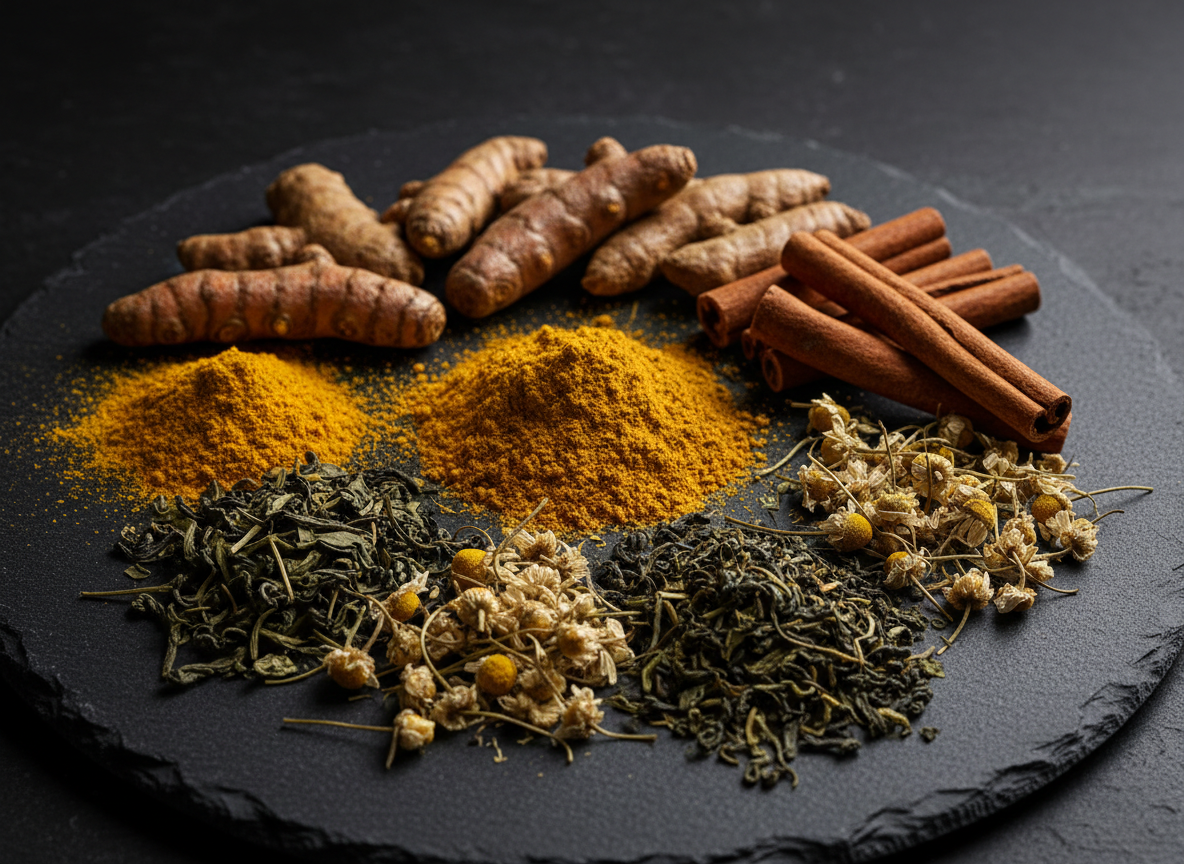
Nature's PharmacyHas Always Been Here
For thousands of years, herbs have activated the same peptide pathways that modern science is just beginning to understand. Here's how to use them.
Herbs That Activate Peptide Pathways
Each herb below isn't just a remedy — it's a key that unlocks specific peptide mechanisms in your body. From amino acid delivery to gut healing to neuropeptide support, these plants work with your biology, not against it.
Turmeric (Curcumin)
What It Supports
Joints, inflammation, gut lining, liver
How It Helps the Body
Curcumin reduces the signalling molecules that drive chronic inflammation throughout the body. It works at the cellular level, not just masking symptoms.
Common Use
Spice, golden milk tea, capsule extract
Connected Body System
Inflammation & tissue repair
Bridge Connection
Supports the same NF-κB inflammation pathway the body uses to regulate healing peptides like BPC-157 and KPV.
How to Prepare as Tea
Simmer 1 tsp turmeric + pinch black pepper + ginger in hot water for 10 min. Black pepper increases absorption by up to 2,000%.
Moringa
What It Supports
Energy, muscle repair, immunity, nutrient density
How It Helps the Body
One of the only plant foods containing all nine essential amino acids. It delivers the raw materials your body needs to build proteins and repair tissue.
Common Use
Powder in smoothies, teas, or soups. Fresh leaves in salads.
Connected Body System
Protein synthesis & cellular repair
Bridge Connection
Provides all essential amino acids — the direct building blocks the body uses to assemble peptide chains.
How to Prepare as Tea
Steep 1 tsp moringa powder in hot (not boiling) water for 5 minutes.
Ashwagandha
What It Supports
Stress response, sleep, hormones, recovery
How It Helps the Body
Helps the body adapt to physical and mental stress by moderating cortisol output. Lower chronic stress means better sleep, repair, and hormonal balance.
Common Use
Powder in warm milk, capsule, or tea before bed
Connected Body System
Nervous system & hormonal balance
Bridge Connection
Regulates cortisol — when cortisol is too high, growth hormone and repair peptides are suppressed. Ashwagandha clears the path.
How to Prepare as Tea
Simmer 1 tsp root powder in milk or water with honey and cinnamon for 10 minutes.
Green Tea (L-Theanine)
What It Supports
Focus, calm, brain health, antioxidant protection
How It Helps the Body
L-Theanine is a unique amino acid that promotes alert calm — focus without tension. It crosses the blood-brain barrier and supports healthy neurotransmitter balance.
Common Use
Brewed loose-leaf or matcha tea, daily
Connected Body System
Nervous system & brain
Bridge Connection
L-Theanine supports the same calming neurochemistry that neuropeptides like DSIP and Pinealon regulate during sleep and recovery.
How to Prepare as Tea
Brew at 170°F for 2–3 minutes. Avoid boiling water — it destroys L-Theanine.
Ginger
What It Supports
Digestion, nausea, gut motility, inflammation
How It Helps the Body
Ginger speeds up gastric emptying and reduces gut inflammation, improving how efficiently your body absorbs nutrients from food.
Common Use
Fresh in cooking, grated into teas, juiced with lemon
Connected Body System
Digestive system & gut
Bridge Connection
Better gut function means better amino acid absorption — and amino acids are what the body uses to build every peptide it produces.
How to Prepare as Tea
Slice fresh ginger, steep in boiling water for 10–15 minutes. Add lemon and honey.
Chamomile
What It Supports
Sleep quality, gut lining, anxiety, inflammation
How It Helps the Body
Chamomile's active compound (apigenin) binds to GABA receptors in the brain — the same pathway that promotes deep, restorative sleep and gut relaxation.
Common Use
Evening tea, dried flowers, extract
Connected Body System
Gut-brain axis & sleep
Bridge Connection
Supports the gut repair and deep sleep windows when BPC-157 and DSIP (delta sleep peptide) pathways are most active in the body.
How to Prepare as Tea
Steep dried flowers in hot water for 5–8 minutes. Best consumed 30 minutes before bed.
Reishi Mushroom
What It Supports
Immunity, stress resilience, sleep, longevity
How It Helps the Body
Reishi contains beta-glucans that train and modulate the immune system — helping it respond appropriately rather than over or under-react.
Common Use
Powder in coffee or hot drinks, tincture, capsule
Connected Body System
Immune system & cellular longevity
Bridge Connection
Activates the same immune signalling pathways that antimicrobial and immune peptides use to regulate the body's defence response.
How to Prepare as Tea
Simmer dried reishi slices in water for 30–60 minutes for a full-strength extraction.
Nettle Leaf
What It Supports
Iron levels, kidneys, joints, inflammation
How It Helps the Body
Nettle is one of the most mineral-dense plants available — providing iron, silica, magnesium, and calcium in bioavailable forms that support countless body functions.
Common Use
Long-steeped tea, cooked like spinach, capsule
Connected Body System
Blood, kidneys & connective tissue
Bridge Connection
High mineral content provides the cofactors enzymes need to assemble and activate peptides — especially iron for oxygen delivery and magnesium for cellular energy.
How to Prepare as Tea
Long-steep: 1 oz dried nettle in a quart jar with boiling water, sealed for 4+ hours. Rich and nourishing.
Mullein
What It Supports
Lungs, airways, mucous membranes, cough
How It Helps the Body
Mullein contains saponins and mucilage that coat and soothe irritated respiratory tissue, helping to loosen congestion and calm inflammation in the lungs.
Common Use
Dried leaf tea for lung and airway support
Connected Body System
Respiratory system & mucosal tissue
Bridge Connection
Soothes mucosal lining through the same tissue-repair pathways activated by anti-inflammatory peptides like KPV and BPC-157 in respiratory tissue.
How to Prepare as Tea
Steep 1–2 tsp dried mullein in boiling water for 10–15 min. Strain through cloth carefully — fine leaf hairs can irritate the throat. Add honey.
Pau d'Arco
What It Supports
Gut pathogens, candida, immune defence, inflammation
How It Helps the Body
The inner bark of the Pau d'Arco tree contains compounds that inhibit fungal and bacterial overgrowth, helping to clear the gut environment so healthy bacteria can thrive.
Common Use
Simmered bark tea, tincture
Connected Body System
Gut microbiome & immune system
Bridge Connection
Clears the gut pathogens that block amino acid absorption and disrupt the microbiome needed for natural GLP-1 and serotonin peptide production.
How to Prepare as Tea
Simmer 1 tbsp dried inner bark in 2 cups water for 20 minutes. Strain and drink warm. Combine with cinnamon or ginger.
Burdock Root
What It Supports
Liver detox, lymph, blood cleansing, digestion
How It Helps the Body
Burdock's bitter compounds stimulate bile flow and liver function, while its prebiotic fibre feeds beneficial gut bacteria that produce short-chain fatty acids.
Common Use
Root tea, roasted as a coffee alternative, eaten as a vegetable
Connected Body System
Liver & digestive system
Bridge Connection
Prebiotic inulin in burdock feeds gut bacteria that directly trigger GLP-1 and satiety peptide release — the same pathway as pharmaceutical GLP-1 agonists.
How to Prepare as Tea
Simmer 1 tsp dried burdock root in 2 cups water for 15–20 minutes. Earthy flavour — combine with ginger and honey.
Irish Sea Moss
What It Supports
Thyroid, gut lining, joints, mineral balance
How It Helps the Body
Sea moss contains a broad spectrum of trace minerals and forms a gel-like coating in the gut that soothes and supports the intestinal lining.
Common Use
Blended gel added to smoothies, teas, or soups. 1–2 tbsp daily.
Connected Body System
Thyroid, gut lining & mineral pathways
Bridge Connection
Provides the mineral cofactors needed for peptide enzyme function, while the gel-like carrageenan supports the same gut lining integrity targeted by BPC-157 and KPV.
How to Prepare as Tea
Blend 1 tbsp sea moss gel into warm water or almond milk with cinnamon and raw honey. Do not boil — heat destroys mineral content.
Lion's Mane Mushroom
What It Supports
Memory, focus, nerve repair, neuroplasticity
How It Helps the Body
Lion's Mane contains compounds called hericenones and erinacines that stimulate the production of nerve growth factor — a protein the brain uses to build and repair neurons.
Common Use
Powder in coffee or tea, capsule, fresh cooked
Connected Body System
Brain & nervous system
Bridge Connection
The only food source known to naturally stimulate NGF — the same neurotrophic factor that Cerebrolysin is designed to mimic.
How to Prepare as Tea
Stir 1 tsp lion's mane powder into hot (not boiling) water or coffee. Mild, slightly earthy flavour.
Holy Basil (Tulsi)
What It Supports
Stress, blood sugar, immunity, inflammation
How It Helps the Body
Holy basil helps balance the body's stress response and supports stable blood sugar, which reduces the hormonal disruption that interferes with repair and recovery.
Common Use
Tea, fresh leaves, capsule extract
Connected Body System
Hormonal & immune system
Bridge Connection
Stabilises cortisol and blood glucose — both of which, when elevated, suppress the growth hormone and repair peptide pathways.
How to Prepare as Tea
Steep 5–7 fresh or dried tulsi leaves in hot water for 5–8 minutes. Naturally sweet and aromatic.
Valerian Root
What It Supports
Sleep depth, anxiety, nervous tension, muscle relaxation
How It Helps the Body
Valerian increases the availability of GABA — the brain's main calming chemical — helping the nervous system shift into rest and repair mode more easily.
Common Use
Tea or tincture 30–60 minutes before bed
Connected Body System
Nervous system & sleep
Bridge Connection
Promotes the deep sleep stages when growth hormone pulses peak and when DSIP (the delta sleep-inducing peptide) is most active.
How to Prepare as Tea
Steep 1 tsp dried root in hot water for 10–15 minutes. Strong earthy flavour — combine with chamomile and honey.
Milk Thistle
What It Supports
Liver cells, detoxification, oxidative stress
How It Helps the Body
Silymarin, the active compound in milk thistle, shields liver cells from toxin damage and supports the regeneration of liver tissue after stress or illness.
Common Use
Capsule extract, seed powder, tea
Connected Body System
Liver & detoxification
Bridge Connection
The liver is where IGF-1 (a key growth and repair peptide) is activated — a healthy liver means better downstream peptide signalling throughout the body.
How to Prepare as Tea
Grind milk thistle seeds and steep in hot water for 10 minutes. Slightly bitter — add cinnamon to balance.
Elderberry
What It Supports
Immune response, viral defence, inflammation
How It Helps the Body
Elderberries contain anthocyanins that strengthen the immune response and have been shown to reduce the duration and severity of cold and flu symptoms.
Common Use
Syrup, tea, tincture, dried berries
Connected Body System
Immune system
Bridge Connection
Supports the immune peptide cascade that coordinates the body's first-line defence — the same network reishi and antimicrobial peptides work within.
How to Prepare as Tea
Simmer 1 tbsp dried elderberries in 2 cups water for 15 minutes. Strain and sweeten with raw honey.
Shatavari
What It Supports
Hormonal balance, fertility, stress, digestion
How It Helps the Body
A traditional adaptogen used for hormonal support in both men and women. It helps regulate oestrogen balance, supports the reproductive system, and nourishes the gut lining.
Common Use
Powder in warm milk, capsule, tea
Connected Body System
Hormonal & reproductive system
Bridge Connection
Supports the hormonal axis that kisspeptin and GnRH peptides govern — the upstream regulators of reproductive hormones like testosterone and oestrogen.
How to Prepare as Tea
Whisk 1 tsp shatavari powder into warm milk with a pinch of cardamom and honey.
Berberine (Oregon Grape / Barberry)
What It Supports
Blood sugar, insulin sensitivity, gut microbiome, lipid metabolism
How It Helps the Body
Berberine activates AMPK — the master cellular energy sensor — and directly stimulates gut L-cells to release GLP-1, mimicking the same pathway as pharmaceutical GLP-1 agonists. It also enriches Akkermansia in the gut microbiome.
Common Use
Capsule extract, tincture, or decoction of Oregon grape root, goldenseal, or barberry bark
Connected Body System
Metabolic & gut microbiome
Bridge Connection
Activates AMPK (like MOTS-c) and stimulates gut L-cell GLP-1 release — the same dual pathway as retatrutide and tirzepatide.
How to Prepare as Tea
Simmer 1 tsp Oregon grape root or barberry bark in 2 cups water for 10 minutes. Bitter — combine with ginger and honey.
Cordyceps Mushroom
What It Supports
Energy, oxygen utilization, stamina, mitochondrial function
How It Helps the Body
Cordyceps increases ATP production and oxygen utilization at the cellular level — directly supporting the same mitochondrial pathways that SS-31 and MOTS-c target. It also improves VO2 max in research models.
Common Use
Powder in coffee or tea, tincture, capsule
Connected Body System
Mitochondria & cellular energy
Bridge Connection
Increases ATP and mitochondrial efficiency — the exact systems SS-31 protects and MOTS-c activates.
How to Prepare as Tea
Simmer 1 tsp cordyceps powder in hot water for 7–10 minutes. Mild mushroom flavor — combine with cacao or chai spices.
Bacopa Monnieri
What It Supports
Memory, focus, neuroplasticity, anxiety
How It Helps the Body
Bacopa enhances the branching of dendrites in neurons — physically growing the brain's communication network. It also boosts BDNF and reduces neuroinflammation, supporting memory and learning.
Common Use
Powder, capsule, or traditional tea
Connected Body System
Brain & nervous system
Bridge Connection
Stimulates BDNF — the same neurotrophic factor that Cerebrolysin and exercise amplify in the brain.
How to Prepare as Tea
Steep 1 tsp dried bacopa in hot water for 8–10 minutes. Earthy — combine with rosemary or lemon.
Ceylon Cinnamon
What It Supports
Glucose control, insulin sensitivity, inflammation
How It Helps the Body
Cinnamon's polyphenols (MHCP) mimic insulin at the cellular receptor, improving glucose uptake. It also slows gastric emptying — a similar mechanism to GLP-1 agonists.
Common Use
Daily spice, tea, or capsule
Connected Body System
Metabolic & blood sugar
Bridge Connection
Mimics insulin signaling and slows gastric emptying — supporting the same metabolic pathways as GLP-1 agonists.
How to Prepare as Tea
Simmer 1 Ceylon cinnamon stick in 2 cups water for 10–15 minutes. Naturally sweet — combine with turmeric and ginger.
Panax Ginseng
What It Supports
Energy, blood sugar, cognition, immune function
How It Helps the Body
Panax ginseng contains ginsenosides that improve insulin sensitivity, stimulate nitric oxide production, and support cognitive function. It is one of the most studied adaptogens for metabolic health.
Common Use
Tea, tincture, or sliced root
Connected Body System
Metabolic & nervous system
Bridge Connection
Improves insulin sensitivity and AMPK activation — supporting the same pathways as MOTS-c and berberine.
How to Prepare as Tea
Simmer 1–2 g sliced ginseng root in water for 15–20 minutes. Earthy and slightly bitter. Combine with honey.
Gotu Kola
What It Supports
Memory, circulation, collagen synthesis, wound healing
How It Helps the Body
Gotu kola is renowned for neuroregeneration — stimulating axonal regrowth and BDNF production. It also supports collagen synthesis and tissue repair throughout the body.
Common Use
Tea, powder, tincture, or fresh leaves
Connected Body System
Brain & connective tissue
Bridge Connection
Stimulates BDNF and neuroregeneration — the same pathways Cerebrolysin and Lion's Mane target.
How to Prepare as Tea
Steep 1 tsp dried gotu kola in hot water for 5–7 minutes. Mild, slightly grassy flavor — combine with mint.
Saffron
What It Supports
Mood, appetite, vision, inflammation
How It Helps the Body
Saffron's crocin and safranal modulate serotonin and dopamine, and recent research shows saffron stimulates GLP-1 release — supporting both mood and metabolic function in a single mechanism.
Common Use
Tea, threads in cooking, or standardized extract
Connected Body System
Nervous system & metabolic
Bridge Connection
Stimulates GLP-1 release and supports serotonin — the same dual gut-brain axis that retatrutide and tirzepatide act on.
How to Prepare as Tea
Steep 5–7 saffron threads in warm (not boiling) water for 5 minutes. Add raw honey. Best in the morning.
Rhodiola Rosea
What It Supports
Stress resilience, fatigue, focus, endurance
How It Helps the Body
Rhodiola modulates cortisol and supports cellular energy production — particularly helping cells maintain ATP output during stress and oxygen deprivation. It is one of the most effective adaptogens for chronic fatigue.
Common Use
Capsule, tincture, or decoction
Connected Body System
Nervous system & mitochondria
Bridge Connection
Supports cellular ATP production under stress — complementing the mitochondrial pathways MOTS-c and SS-31 regulate.
How to Prepare as Tea
Steep 1 tsp dried rhodiola root in hot water for 7–10 minutes. Mildly floral and slightly bitter.
The Daily Tea Ritual
Build a simple daily tea practice that supports your body's peptide production.
Green Tea + Ginger
L-Theanine for focus, ginger for gut motility and amino acid absorption
Turmeric Golden Milk
Anti-inflammatory support, enhanced nutrient bioavailability with black pepper
Chamomile + Ashwagandha
Gut repair during sleep, cortisol regulation, neuropeptide balance